
The House Edge Is a Fee, and Every Game Prices It Differently
Every casino game charges a fee for the privilege of playing, even though nobody prints a receipt. That fee is the house edge, expressed as a percentage of every dollar wagered over the long run. European roulette takes 2.7 cents per dollar spun. A well-played blackjack hand costs closer to 0.5 cents. The number never appears on the felt, but it shapes every session whether the player notices or not.
Thank you for reading this post, don't forget to subscribe!Most players discover this the hard way, chasing a losing streak instead of reading the math first. A session at an x3 bet casino table makes the pattern obvious fast: two games with identical stakes can drain a bankroll at wildly different speeds, purely because their built-in fees differ. Knowing the rate before sitting down changes how long a budget actually lasts.
What the House Edge Actually Measures
The house edge is not the chance of losing a single hand or spin – it is the average share of total wagers the casino keeps after thousands of repetitions. A 5% edge on slots doesn’t mean five out of a hundred spins lose; it means that across a long enough run, the machine returns 95 cents for every dollar fed through it. Short sessions swing wildly above or below that average, which is exactly why the number feels invisible in the moment.
Fixed-Odds Games
Roulette, craps’ proposition bets, and most slot reels have a fee baked directly into the payout table – it never moves regardless of strategy. A single-zero roulette wheel pays 35-to-1 on a number that has a 1-in-37 chance of hitting, and that gap is the entire edge, fixed at 2.7% forever.
Skill-Adjusted Games
Blackjack, video poker, and certain poker variants let a player’s decisions shrink the built-in fee toward its theoretical floor. Basic strategy alone pulls blackjack’s edge under 0.5% at most tables; sloppy play can push the same game past 2% without the rules ever changing.
Three habits separate players who pay less over a year of sessions from those who don’t:
- Checking a game’s published RTP or edge before committing a bankroll to it.
- Hunting for single-deck tables with liberal doubling rules, since that tweak alone shaves real percentage points off the dealer’s take.
- Skipping side bets and progressive add-ons, which almost always carry a steeper edge than the base game.
Why the Same Game Can Carry Different Edges
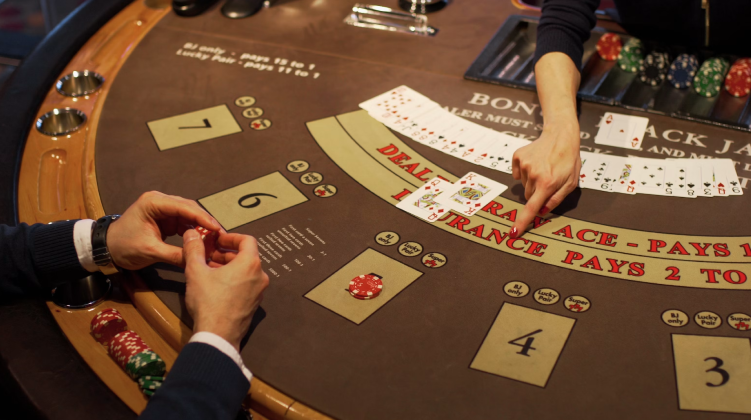
Two tables labeled “blackjack” rarely charge the same rate. Payout on a natural blackjack, whether the dealer stands or hits on soft 17, and how many decks are in the shoe all move the number independently. A 6:5 payout instead of the standard 3:2 alone adds close to 1.4 percentage points to the house’s take, turning a fair game into a poor one with no visible change at the table.
| Game | Typical House Edge | Player Influence |
| European Roulette | 2.7% | None |
| American Roulette | 5.26% | None |
| Blackjack (optimal play) | 0.3%-0.5% | High |
| Video Poker (Jacks or Better, full pay) | 0.46% | High |
| Slot Machines | 2%-10% | None |
| Baccarat (Banker bet) | 1.06% | None |
Baccarat looks simple, but its three bets carry three different fees – the Banker wager sits near 1%, while the Tie bet balloons past 14%, one of the steepest charges in the building despite the payout looking generous on paper.
How Volatility Changes the Feel of the Fee
A low edge doesn’t guarantee a smooth ride, because volatility – how wildly results swing between wins and losses – runs on a separate axis entirely. Video poker can carry a tiny theoretical fee yet still produce long dry stretches, since its payout is concentrated in rare, large hands rather than frequent small ones.
Slots sit at the opposite end: many titles combine a moderate edge with high volatility, meaning most spins return nothing while a handful pay disproportionately large multipliers. That combination is why a slot session can feel far riskier than its published RTP number would suggest on its own.
Reading the Fee Before You Sit Down
Regulators require licensed operators to publish RTP figures, usually inside a game’s help screen or paytable, and that single number is the fastest way to compare two options before wagering a cent. A game advertising 96% RTP is charging a 4% fee, no matter how the marketing around it is worded.
Treat the house edge the way a shopper treats a price tag: compare it before buying, not after the receipt prints. The games with the lowest published fee, paired with disciplined bankroll limits, are simply the ones that let a given budget last the longest.